When Sadness Is At Your Door
More than a year ago, I decided to add a section to the blog called “Emotional Support Books”. It’s taken me some time to work on it and what I have is definitely not comprehensive. But with work and family life, plus my own writing and reading and other projects, I kept forgetting to get back to it. A few weeks ago, I decided to make it at least a ‘working’ page and so for the work-in-progress, you can click the above link. (And feel free to contact me via our contact page if you have other good suggestions.)
There are a lot of self-help books out there and a LOT of books about tantrums and feelings. In fact, you may notice that the most popular of them are not among my list. Those are already readily available. What I decided to include were books that I felt handled the topic with a bit of finesse. Not too preachy, not too-over-the-top, and they MUST have awesome illustrations.
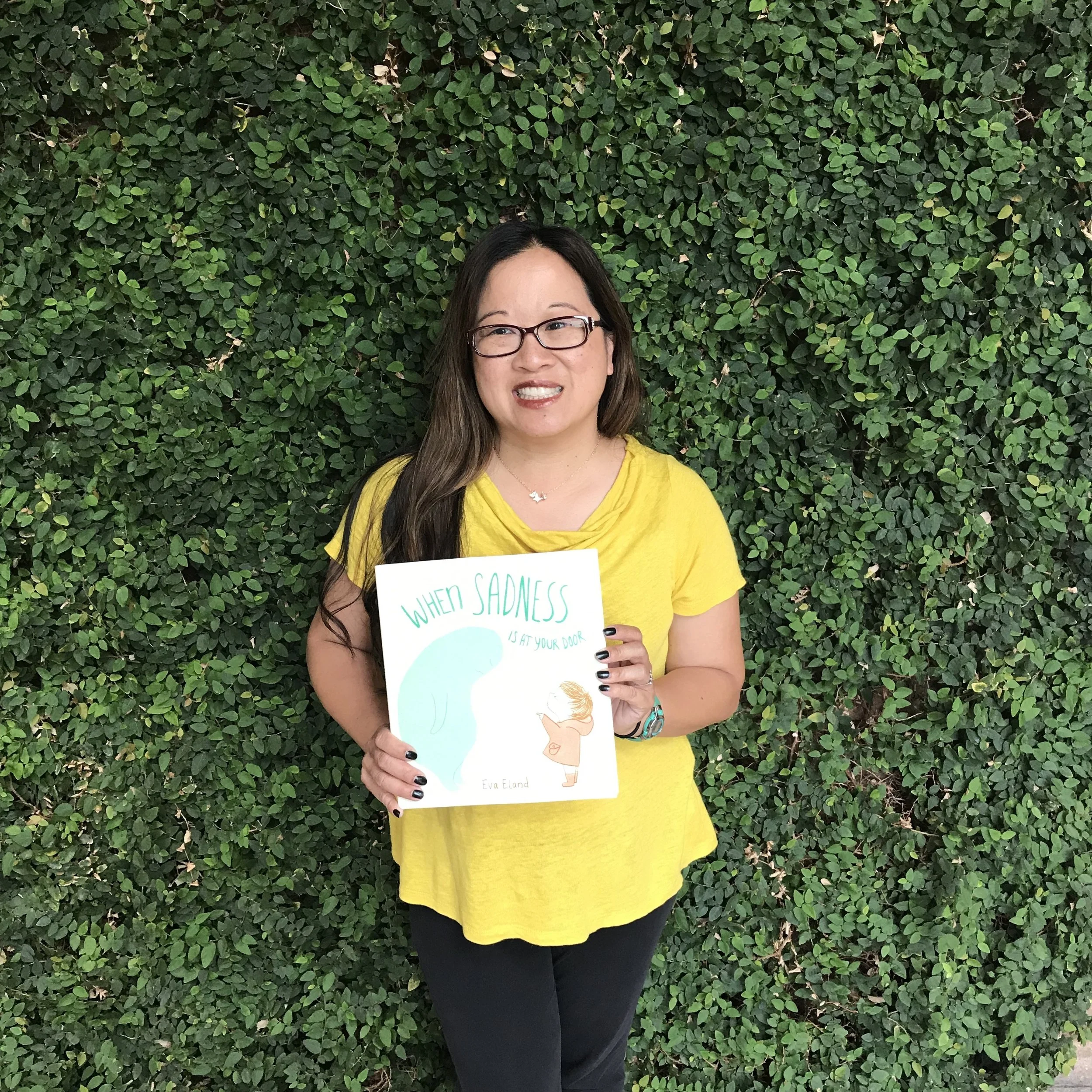
When Sadness Is At Your Door by Eva Eland is one such book.
Eva Eland illustrates Sadness as an overwhelming blue blob that haunts the main character. What I love about When Sadness is at Your Door is the fact that the text emphasizes that it’s okay to feel sad. That it’s normal to feel sadness sometimes. And it has a lot of welcome ideas about how to cope with that sadness without feeling preachy or too instructive. The text and the illustrations are accessible and real and I think very relate-able for kids ages 4 and up. Even for your older kids, though they may scoff at its simplicity, I think there’s a lot discussed in the text and sub-text that can ring true.
In Practice
How often do I talk about SADNESS with my patients? Every day. But I’ll be honest and say that sometimes I have to skim over it if everything seems to be going ‘okay’ for my patients. Why? It’s always about time. The reality is that we are often overbooked and have to focus on a few things at a well check. If there’s more going on, I will not ignore it, however, and that’s how I’m usually running late.
Sometimes it’s just a quick chat about the PHQ-9—basically a depression screen that talks about the various things you can be feeling with depression. (Think SIGECAPS, for my fellow health care professionals out there.) And while I think it’s a quick mention, I often try to emphasize the fact that it’s normal to feel sad or depressed sometimes, for every single kid. And I try to mention when it’s time to seek help.
Maybe it doesn’t matter. But I like to think that if I’ve helped one or two kids, then it’s worth it.
I’ve mentioned before that every week I meet an Evan Hansen—meaning that every week I meet someone who is depressed or has been through depression. And it’s true. And I’m ever so happy when I see someone again who is open to talking about how they are feeling.
There’s a lot of anxiety in our kids. A lot more pressure than when I was growing up. So I think it’s good that we talk about it all the time so that depression, sadness, anxiety do not become taboo topics.
Sometimes I do mention to our patient families that there has been a wait due to an emergency. (Without giving details, of course, because I respect patient privacy.) And if they’ve seen us running around giving breathing treatments or even seen the EMT crews coming to pick up a patient, they don’t question it. But often I wonder if I can just explain that I needed 10-15 extra minutes with the last two patients because there was a lot to talk about. Or, again to protect patient privacy, I’ll explain that it’s been a busy afternoon. Maybe it’s not an ‘emergency’ per se, but it’s important to take that extra time.
I hate running behind. but I hate rushing through too. There definitely needs to be a balance, but until primary care providers are deemed as important as specialists, you will always have your doctor running behind.
Back to the Book:
Back to the book at hand: I always debate if I should write my own doctorly musings or not when I recommend a book, but I figure it you want a Good Reads review, you’d go there. The whole reason I started this blog was to recommend books from a pediatrician’s perspective.
And as a mom and a pediatrician, the reason that When Sadness Is At Your Door caught my eye is that I thought it would be an excellent springboard for discussion, no matter the age of your child. (Well, as long as they’re old enough to comprehend.) So I’ve left the book laying around the house for both Little Lion and Mini Me to peruse. And I’m debating getting a copy for the office too. For emergencies. And the little and big moments.
Tell Dr. Bookworm!
Have you read a picture book ( or chapter book) that you think would be a good read for kids struggling with sadness or emotions? Let me know your suggestions in the comment section below, or feel free to email me at drmelaniebookworm@gmail.com.